Medical Thin-Wall PI Tubing: From Material Properties to Design Requirements
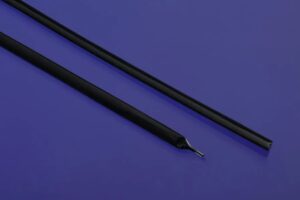
Thin-wall polyimide tubing is one material to evaluate for precision medical tubing designs. Thin walls help allocate limited diameter space. Dimensions, strength, friction and reinforcement should be selected together for the intended device application.
Yan Fun assists with PI tubing selection and supply enquiries for medical applications. This article covers general properties, potential uses and specification preparation. Supply part numbers, documents and processing conditions require separate confirmation; final devices still require applicable validation.
Why Consider Thin-Wall PI Tubing?
Thin walls and small sizes: allocate ID and OD space first
When catheter OD is limited, internal passages, wires or other components still need space. Thinner walls can preserve more internal room, but wall integrity, assembly loads and cut condition must also be checked.
ID determines space for internal parts; OD determines fit with outer layers and adjacent components; wall thickness connects both. Provide dimensional limits rather than only saying “thin wall” or “small bore”.
Design example, not a supply specification:With OD unchanged, increasing wall thickness reduces ID. Nominal wall thickness is (OD − ID) ÷ 2. Actual design also requires tolerances, eccentricity and assembly clearance.
Strength and flexibility: evaluate the complete structure
Manufacturer literature identifies mechanical strength and thermal stability as PI properties. Material tensile strength does not equal finished catheter pushability, kink resistance or torque transmission. These depend on dimensions, length, wall thickness, interlayer bonding and reinforcement.
For repeated bending or tortuous paths, describe bending location, curvature or radius, cycle count and required lumen patency after bending. Straight-tube dimensions and the material name alone are usually insufficient for selection.
Dimensional stability and surfaces: assembly consistency
Precision assembly requires not only ID and OD but also length, end faces, burrs and contact surfaces. Validate sliding and fit using actual components, and include appearance and measurement conditions in acceptance specifications.
Standard, Lubricious and Reinforced PI: What Differs?
Specialist tubing manufacturers offer different materials and structures. These are comparison directions, not a statement that Yan Fun supplies every combination in the table. Available part numbers and documents must be confirmed individually.
| Type | Evaluation focus | Additional requirements |
|---|---|---|
| Standard thin-wall PI tubing | Thin walls, dimensions and basic material properties | ID, OD, tolerances, length, assembly and contact conditions |
| Lubricious or composite tubing | Specified material structure and actual friction | Contact parts, sliding method, friction validation and documents |
| Braid or coil reinforcement | Pushability, torque, bending and kink-resistance requirements | Reinforcement type, overall dimensions, bending location and acceptance method |
“More slippery” is insufficient to describe lubricity needs, and “stiffer” is insufficient for reinforcement. Explain the assembly or use problem to be improved; this helps identify candidate part numbers better than adding material names alone.
Potential Medical Device Applications
Specialist manufacturers list cardiovascular catheters, neurovascular devices, urological retrieval devices, and balloon and stent delivery systems as application areas. This describes potential uses, not validation of any individual PI tube for those devices or a specific Yan Fun end-device supply record.
Turn Applications into Design Questions
- Internal catheter passage:What must the passage accommodate? Can internal components pass through? Must a specified patency be maintained after bending?
- Sleeves for small components:Which parts need fixation, isolation or protection? Does the application involve sliding, heat processing, adhesion or local loads?
- Multilayer and reinforced structures:Which layers provide surface functions and which provide mechanical functions? Are layer dimensions and bonding processes compatible?
These are engineering evaluation questions; the device developer must confirm the design. Clear use requirements help determine whether standard tubing, special materials or reinforcement are worth sampling.
Sterilisation, Biocompatibility and Documents
Describe contact conditions and processing first
Specify whether the material contacts the body, contact location and duration, planned sterilisation method and cycles, and processing steps. Different contact conditions and device applications may require different evaluations and documents.
Raw material data, cut parts and final devices are different validation subjects. Check post-sterilisation changes in dimensions, appearance, mechanical function and interlayer bonding against design needs.
One Test Does Not Replace Complete Validation
USP Class VI or other test data for one material grade does not mean all PI tubing has the same documentation or that a finished medical device has complete safety validation. List required tests or documents, applicable part numbers and revisions, then confirm what the supplier can provide.
Request material traceability, batch documents, composition information and clean packaging during the enquiry stage. This avoids selecting dimensions before discovering that documentation does not meet requirements.
Four Stages of Sample Evaluation
- Dimensions and appearance:Check ID, OD, wall thickness, length, end faces and surfaces using agreed methods.
- Assembly:Use actual components to confirm insertion, sliding, adhesion and interlayer fit.
- Function:Check bending, pushability, torque and passage function against design requirements.
- Processing and finished parts:Recheck relevant performance and necessary documents after planned processing and sterilisation conditions.
Information for Your Yan Fun Enquiry
- ID, OD, wall thickness, length and each dimensional tolerance.
- Tubing location and function within the device, and mating parts.
- Standard, lubricious or reinforced requirements; include any existing part number.
- Colour, light transmission, haze, end-face, surface and processing requirements.
- Body contact, sterilisation, batch traceability and required test documents.
- Drawings, sample and production quantities, lead time and existing acceptance criteria.
Frequently asked questions
Is thin-wall PI tubing always transparent?
The material name alone is insufficient. To see markings or parts inside the tube, specify colour, light transmission or haze requirements and assess visibility using the actual part number, thickness and components.
Can existing tubing be replaced by the same size?
Matching dimensions is only the first condition. Compare structure, friction, flexibility, processing, sterilisation and documents, and verify device function after replacement.
What if you have a sample but no complete drawing?
Send sample photos, known dimensions, the original part number and application to identify missing specifications. Formal selection still requires measurable dimensions and functional criteria; photos do not replace full measurement.
Product Information and Enquiries
check out Medical thin-wall PI tubing product page. Email drawings, dimensions, applications and document requirements to sales@yanfun.tw, or call 02-2958-8715。
Scope of This Guide
This article covers general material properties and specification preparation. Yan Fun supply part numbers, structures, processing and documents must be confirmed individually. Material data does not replace functional, safety and process validation of the final medical device.
Selecting and Enquiring About Medical Polyimide Tubing
Common English names include Medical Polyimide Tubing, PI Tubing and Thin-wall Polyimide Tubing. Chinese spellings include 聚醯亞胺管 and 聚酰亞胺管. For thin-wall catheter tubing, first describe its location and function within the complete device.
Are catheter liners and standard PI tubing interchangeable?
Catheter-liner or microcatheter tubing requires checks of dimensions, bending, interlayer bonding and contact conditions against the structure. The same material name does not establish interchangeability. Material documents, biocompatibility and sterilisation suitability must be confirmed for the specified part number.
Which specifications are needed for a medical PI tubing quote?
Provide ID, OD, WT, dimensional tolerances, cut length, sample quantity and estimated demand. Describe device application, contact location and duration, processing and required documents. Yan Fun can assess supply feasibility and pricing against these specifications.
Can specifications in mil or inches be checked?
Send the original drawing and units. 1 mil = 0.001 inch = 0.0254 mm. State whether the value is ID, OD or wall thickness to avoid ambiguity.